|
Dr. Vivek Murthy: ‘There’s a Tsunami of Misinformation Out There’
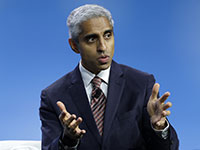 | |
Dr. Vivek Murthy is unique among U.S. surgeon generals, having served two non-consecutive tenures under multiple presidential administrations—from 2015 to 2017 under Barack Obama and Donald Trump and from 2021 to 2025 under Joe Biden. That bifurcated experience gave him a unique perspective on American public mental health, leading him to focus on issues such as social media by young people, loneliness, and health worker burnout.
Murthy touched on all of these issues in conversation with APA President Theresa M. Miskimen Rivera, M.D., as part of the William C. Menninger Memorial Lecture on Monday. Here are five takeaways from his remarks, edited for length and clarity:
1. Why mental health? “I could tell you that it’s because of my own struggles with mental health when I was a kid, and that would be true. I could also tell you it’s because, as a clinician, as an internist, I saw many of my patients also struggling with mental health concerns, and that would be true as well. But the thing that really pushed me over into it being a priority when I was surgeon general was what I was seeing all over the country when I traveled.
“One of the great joys and blessings of serving was having a chance to meet people in so many parts of our country—small towns and big cities, people who were older, people were younger, people who were rich, people who didn’t have money, and all kinds of folks. It helped me understand that what I had struggled with in my own life, what I was seeing in the lives of my patients, these were not anomalies, but these were far more common all across the country. When people would come and share some of their struggles, it was often with a little bit of shame. It was very clear, especially with parents, as I saw them worrying about the mental health struggles of their kids, that this is fundamentally impacting our lives in a much more profound way.
|
|
|
|
“That’s why I chose to focus on mental health—because to me, mental health is the fuel that allows us to show up in life, in our families, in our workplaces, in our schools, in our neighborhoods. If that fuel line is pinched up, it affects everything else, right? And people intuitively notice when you talk to them about it. They know, for example, that if they’re struggling with serious depression, or if they’re struggling with the acute stress of having a child who is sick, that impacts how they show up at work. We see that, somehow, we still treat mental health as something that is off to the side, but I’m grateful to see the shift over these last few years in how our country, how the press, how policymakers have all started to think more deeply and intentionally about mental health. We have a lot more work to do, no doubt, but this is an essential issue, and that’s why I'm so grateful for all of you and the work that you. This is a time when your voices, your perspectives, your skills are going to be more needed than ever, because people more and more are awake and are looking for solutions.”
2. The loneliness epidemic: “What’s interesting to me is that I started talking about loneliness toward the end of my first term [as surgeon general], then really dug into it during my second term, producing a report on it. In between, I wrote a book on it. I keep waiting for it to become a topic that is sort of dull, but that still hasn’t happened, because it’s still so deeply felt—that the cultural forces and technology forces around us that are isolating us are actually accelerating. This sense of isolation is increasing.
“Take artificial intelligence, for example, and take social media. Technology is not the only force that is driving loneliness and isolation—I just want to be very clear about that. We’re seeing diminished participation in the organizations that used to bring us together, like service organizations faith organizations. We’ve been seeing that decline for a half-century now. We also tend to go out less, and we move around a lot more, and we also change jobs, and all that means that we leave communities behind. But technology’s played its own role. It’s made it less necessary for us to go to the grocery store, the retail store. Just gathering online—it’s convenient, but there’s a human cost as well.”
3. Especially social media and AI: “The impact of social media on kids in particular has been really profound. With the benefits that do exist, the harms are actually quite significant. This is a place where it’s really important for our medical profession—particularly those who care deeply about mental health—to be proactive and to lead public discussions and discussions with policymakers. What many of the tech companies did on the social media front is, they shifted the burden to everyone else. Instead of saying, ‘We shoulder responsibility to demonstrate our products are safe for kids,’ they said, ‘It’s everyone else’s responsibility to demonstrate beyond any shred of doubt that our products are absolutely harmful. Anything short of that, there’s nothing to see.’ The same thing with AI, unless we can learn something different.
“Now, I will just honestly just say this: Our policymakers at a federal level failed in their responsibility to protect kids when it came to social media, and they’re currently on the road to failing as well when it comes to protecting our kids from the arms of AI. Even though there’s bipartisan support for doing something, nothing ever seems to happen, and so the question is: Where is the pressure going to come from for them to do something? Who is going to speak up on behalf of the millions of parents out there who see their children struggling and don’t know what to do—who think that those troubles are purely the result of their failures as a parent? The people who stand up for those parents, for those kids who push policy makers and technology companies to do the right things, those people should be us.”
|
|
|
|
|
4. Misinformation, disinformation, and malinformation: “I wish there was a simple answer to this. The paths on which misinformation is flowing into our lives—and disinformation as well—have expanded and grown extraordinarily in the last four or five years. There’s a tsunami of misinformation out there, and especially with AI, it’s very hard to tell what’s real. Even a few years ago, in the throes of COVID, we started to see scientific peer-reviewed publications being posted on social media that were actually completely fabricated.
“What we also saw during the pandemic was interesting, which is that people fundamentally had a need to trust. What’s shifting is who they trust, what they trust. There’s less trust in institutions, but people still trust the people they know. People still trust their individual doctor, or the nurse who took care of their family, or maybe a department of public health in their community if they had a lot of interaction with it. We want to build trust again. What we have to ask ourselves is, how do we go into communities and show up with people? This is different from showing up in the clinic one-on-one with a patient.
“This is not about telling clinicians, “Hey, we need to add this other big chunk of work to your already-overwhelmed life.’ This is a broader systems issue of saying, how can our institutions recognize what’s needed from a health perspective and recognize that the scale of our problems won’t be met if we confine clinicians to the exam room and to the treatment room alone. We have to find our way into communities, because the best time to build trust is before the crisis comes. We learned that the hard way during COVID.”
5. Physician and health worker burnout: “One of the reasons we issued a report on this when I was in office is that the rates of burnout are far higher than what the public understands, and the threat to emergency and routine care is far greater than what policymakers are aware. I think a lot of times institutions look at the clinical burnout crisis and they think, well, this is primarily about safety, it’s about pay, and it’s about administrative burden. And it’s partly about those things. Those are important.
“I think what they miss sometimes is that it’s also about agency. It’s also about trusting your leaders to do the right thing to take care of it, and it’s also about your sense of community. Do you have one or not? Because we know that, after training, clinical work can be incredibly isolated. You’re on your own, making big decisions. People need to know that their leaders have their best interests at heart and are fighting for them. That is essential, and I worry in a system where we’re hearing too many health systems are getting taken over by private equity, by leaders who are trying to squeeze every ounce of profit, even when it’s coming at the expense of patient outcomes.” ■
|
|
|
|
|