May 19, 2026 | View Online | Psychiatric News

Question of the Day: What Advice Do Medical Entrepreneurs Have?

On Monday, Aviv Kushnir, M.A., walked onto the Mental Health Innovation Zone (MHIZ) stage, then turned and walked off. He’d forgotten his phone. He looked flustered and nervous. His shoulders were hunched as he finally positioned himself in the center of the stage.

Behind him, an avatar appeared on the screen. “Hi, Aviv,” it said. “I understand you’re feeling anxious about the APA conference.” The MHIZ audience watched as Kushnir selected an avatar to represent himself, another avatar to represent his anxiety (he chose a tornado), and a setting in which to talk with his anxiety—a park bench on a rainy night.

“You keep lowering my confidence, making me feel I don’t belong here,” Aviv Kushnir told his anxiety.

“You’re not good enough for this event,” his anxiety responded in a deep, threatening voice.

Advertisement

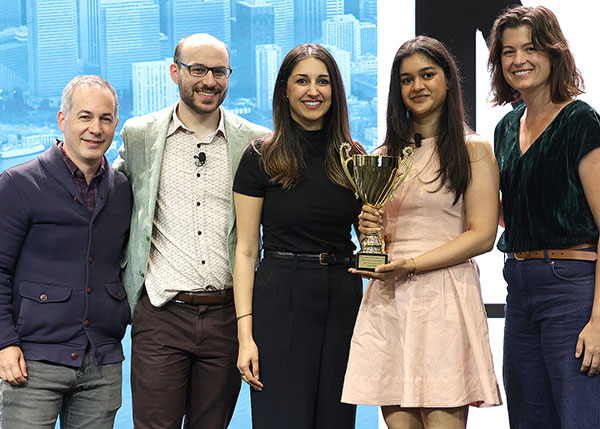
From left: Sahib Khalsa, M.D., Ph.D., judge and director of anxiety disorders research at the University of California, Los Angeles, Semel Institute for Neuroscience and Human Behavior; Joshua Cohen, M.D., Ph.D., host and member of APA’s Committee on Innovation; Neha Chaudhary, M.D., judge and chief medical officer of Headway; Dhati Oommen, senior at Harvard University and co-founder of MoodFind, winner of the Most Promising Idea Award; and Rebecca Mitchell, M.D., judge and co-founder and managing partner at Sprout Capital. 

The demonstration was part of a program called WellPlay developed by Aviv and Achi Kushnir, B.Sc., brothers from Israel who were pitching WellPlay in the Psychiatry Innovation Zone, APA’s “Shark Tank”–style competition. Hosted by APA’s Committee on Innovation, the program included four competitors who pitched their products to a panel of judges: Neha Chaudhary, M.D., a child and adolescent psychiatrist at Massachusetts General Hospital and chief medical officer of Headway; Rebecca Mitchell, M.D., co-founder and managing partner at Sprout Capital; and Sahib Khalsa, M.D., Ph.D., director of anxiety disorders research at the University of California, Los Angeles, Semel Institute for Neuroscience and Human Behavior.

The winner of the Most Promising Idea Award was MoodFind, an artificial intelligence (AI) program that screens for depression, stress, and anxiety using an individual’s micro expressions—extremely brief, involuntary facial movements.

The Audience Choice Award went to Aviv and Achi Kushnir’s WellPlay, which provides mental health support to patients using AI and psychodrama—which combines roleplaying and psychotherapy.

Advertisement

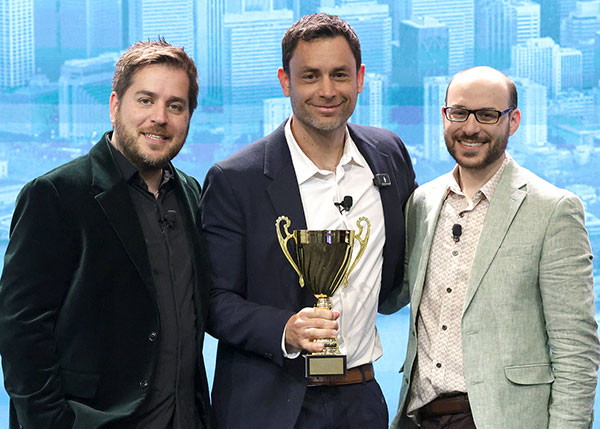
From left: Aviv Kushnir, M.A., CEO and founder of WellPlay, which won the Audience Choice Award; Achi Kushnir, B.Sc., chief operating officer of WellPlay; and Joshua Cohen, M.D., Ph.D., host and member of APA’s Committee on Innovation

Psychiatric News asked the Psychiatry Innovation Zone presenters: As medical entrepreneurs, what advice would you give someone hoping to be where you are now?

“Take risks,” said Dhati Oommen, a senior at Harvard University and co-founder of MoodFind. “Doing something like this is risky, and it means chasing something that you probably won’t get a lot of validation for—and that’s okay.”

Anita Manokore, M.S., CEO and founder of Wise Health Technologies, suggested: “Take chances. No matter if you think that it’s too big for you or it’s too small, you should always take chances.” Manokore presented on a program that uses wearable technology to monitor patients with schizophrenia and other psychotic disorders between appointments, so physicians can tell if the patients may need support more immediately.

Catherine Agarwal, B.S., and Lillian Agarwal, B.S., were presenting on sorila, an app that uses gamification to encourage users to keep track of their mental health symptoms and seek help if necessary. “If you think you have a good idea,” Catherine Agarwal said, “find the people who believe in you, no matter who they are.”

“Always be open to new opportunities,” Lillian Agarwal added. “One doctor that I worked with on a rotation told me: ‘It’s better to try and fail than to not try and guaranteed fail.’” ■