|
Sylvia Acevedo: ‘You Can Transform Possibility Into Probability’
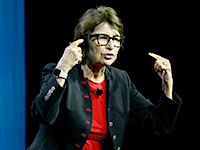
From the outside, Sylvia Acevedo’s life story looks like a straight-shot ride on the American Dream. From her early life growing up poor in a predominantly Spanish-speaking neighborhood in Las Cruces, New Mexico, she went on to work as a NASA rocket scientist on the Voyager 2 project; a corporate executive with IBM, Apple, Autodesk, and Dell; a White House commissioner in the Obama administration; board member and then CEO of the Girl Scouts; and a bestselling author.
It seems perfect. Except that, when Acevedo was 28, she experienced a “nuclear explosion” of family tragedy: Her father killed her mother and then himself. The aftermath of that unexplainable calamity, which she shared with Annual Meeting attendees during the “Enlightened Voices: Shared Futures Plenary” yesterday morning, is as responsible for who she is today as her many successes. Here are five takeaways from her remarks, edited for length and clarity:
1. Selling cookies as a Girl Scout: “[The troop leader] said, ‘You never leave a sale until you hear no three times.’ Now, Mexican-style kids normally don’t talk to adults. They don’t initiate. That’s a hard way to sell cookies, so that lesson was very important. First, you sell to your family, then you sell to people in your church, etc. I was still a long way away from my goal, so I knew I was going to have to talk to strangers, so I chose a friendly one first, which was a neighbor. I went up to her—she’s just getting out of her station wagon—and I said, ‘Would you like to buy some Girl Scout cookies?’ She looked at me, and she said no. So, I asked a different question. I said, ‘I imagine there is somebody in your house that might want to buy Girl Scout cookies?’ But she looked at me, and she said no. And so, then I asked, ‘Would it make anybody’s day if you bought a box of cookies?’ And she looked at me like, ‘Yes, I’ll buy a box.’ So, what did that teach me? Persistence. Resilience. How to find the common ground.”
|
|
|
|
2. Working at NASA: “That was my first job out of college. I was able to work as a rocket scientist on the Voyager 2 project. And that was such an exciting time, you know? You had to be there when the images were coming back, when the data was being streamed. It's not like now you can catch it on your phone or on your digital device. We literally took sleeping bags and slept in the cafeteria, because when you were having a sweep of the moons or Jupiter, you had to be there to collect the data. I loved it. I was living my dream.”
3. Recovery from trauma: “All too often in America, we have violence, and you hear about the violence but you don’t hear about the recovery, and so that was why I wanted to include this story. I was very fortunate. I had a great boss at IBM, and he gave me the space and grace that I needed. I took about three months off, and when I came back to work, my colleagues really shouldered much of the workload. I redoubled my efforts to work, and yes, I still was ambitious, and yes, no one’s going to stop me, but there was something else now that was fueling me, and that was anger. And that anger—surprise, surprise—was directed at authorities, because they represented my father.
“While talking to people, they often mentioned what a trauma I had been through, and even though when that initially happened, I’d worked with a therapist, I’d gotten to the point that I was capable enough that I just powered through. But now I realized I needed to get to the thing that I was afraid of the most, the thing I knew I needed to do but that I was scared of the most, and that was forgiveness. So, one day I went to a bookstore, and I was looking for trauma books, and there was this book about PTSD. They had a quiz, and I did the quiz—I answered all the questions—and I’m like, ‘Oh, I guess I have PTSD.’
“I found a therapist who was a specialist in trauma, and it was one of the hardest things to do for me, because I knew I would have to face the pain that I had really shielded myself from, but at that point I realized I was not living the life of my potential. My anger was no longer propelling me, but it was a wall, and so I began working with her. One day, she made this comment off the cuff about fathers, and I scoffed. As a good therapist, she keyed into that, and she said, ‘This week I want you to look around and see fathers doing wonderful activities and engaging wonderfully and lovingly with their children.’
I realized that I needed to work on gratitude and getting back to recovery. Growth started with gratitude, and it also started with forgiveness. At one moment, I finally sat down and I wrote my father a letter, and I told him that I forgave him and that I loved him. Then I wrote my mother a letter, also forgiving her and telling her that I loved her. And then I wrote a third letter. The third letter was to me, telling me that I forgave myself for carrying all that anger. I wrote those letters, and then I let them go, and at that moment, because of the way everything changed within me, the world really did begin reacting different to me.”
|
|
|
|
|
4. CEO of Girls Scouts: “It felt like a full-circle moment, because all of a sudden I was in the position of the leader of the organization that had changed and meant so much in my life. One of the first parents that contacted me said, ‘Why should my daughter be in Girl Scouts? She’s just going to sell cookies and make macaroni necklaces?’ I realized we needed new programming, because this was the digital age and girls had mobile devices in their hands, and I didn’t want them just to be users of technology—I wanted them to be the creators, inventors, and designers of technology. We created 126 new science, technology, engineering, and math badges in things like cybersecurity, in things like robotics, coding, space.
“I wanted to make sure that all Girl Scouts had access to and were trained in civics as well, and then also entrepreneurship, because of the great Girl Scout cookie program. We were very successful. Over a million badges were earned during my tenure, including 180,000 in cybersecurity.”
5. The story of her life: “It’s about recovery. It’s about resilience. Those are the things that get you through, and that’s definitely what has gotten me through. When I talk, I really want people to understand: You can transform possibility into probability, because decisions matter. Your life circumstances, yes, are important, but they can be overcome, and they are overcome by the decisions that you make on a daily basis. That’s one of the reasons I really wanted to share my story, because we don’t frequently talk about recovery, and I wanted to share that it is possible, even in the most challenging times. The focus is not on your circumstances but on your decisions, and I know everyone can do this, because after all, it’s not rocket science.” ■
|
|
|
|
|