|
“It makes sense that fish oil might work since the brain is about 50% fat,” Arnold said. Along those same lines, he highlighted a pilot study he recently conducted involving cholesterol supplementation in children with autism. “Cholesterol gets a bad rap, but the problem with elevated cholesterol is you have too much of a good thing; cholesterol deficiency is just as bad,” he said.
The rationale for his pilot was a rare disorder known as Smith-Lemli Opitz syndrome, in which people lack a key enzyme that makes cholesterol. As many as 80% of people with this syndrome have comorbid autism, suggesting there may be a broader connection between cholesterol and autism. His preliminary findings appeared to support that notion, as children who received 450 mg/day cholesterol supplements (about two eggs) showed improvements in anxiety and irritability relative to placebo.
In addition to healthy fats, Arnold noted some data suggest that broad-spectrum micronutrient supplements (containing multiple vitamins and minerals) have a positive impact on not only GI problems, but also sleep problems and irritability. Micronutrients have also shown positive effects for attention and hyperactivity in children with attention-deficit/hyperactivity disorder, which is a common comorbidity in children with autism.
“Several vitamins and minerals are cofactors in mitochondrial activity,” Arnold said (mitochondria are the cell’s energy generators). There is speculation that at least some autism cases might be caused by mitochondrial damage from external stressors such as pollution, pesticides, and lead, and these supplements help mitigate some of the damage. As with fish oil supplements, these micronutrient pills do not use excessively high doses, so it may be a low-risk option worth trying.
As Arnold noted during his discussion of other agents including antipsychotics (to treat irritability) and stimulants (for attention or hyperactivity), there are almost no good medications for core autism symptoms, while the choices for secondary symptoms are generally mixed at best. (The exception is risperidone although it carries some potent side effects.) Therefore, it can’t hurt to look at this disorder from a new angle.
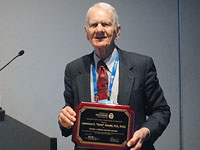
It was a sentiment echoed by John Campo, M.D., the Leonard and Helen R. Stulman Professor and director of child and adolescent psychiatry at Johns Hopkins Medicine, during his opening remarks for the award lecture. “[Arnold] has a tremendous amount of intellectual curiosity. He doesn’t think outside the box; he asks, ‘What box?’ ■
|